Understanding the Fire Performance Benefits of Polymeric Exteriors
Built-In Protection
Meet or Exceed the Industry Standards for Safety
According to the U.S. Census Bureau,* vinyl siding is the most popular choice for exterior cladding in residential homes in the Midwest and New England.
For years, polymeric products have been recognized materials that meet or exceed building codes and industry standards for safety.
Approved for use in all types of construction, including:
- Noncombustible rated structures up to 40'
- One-hour fire-rated assemblies
- Wildfire zones (up to the most severe settings in most cases, as products do not typically contribute to the growth of the fire)
- Other fire-resistive construction up to highest risk categories in most instances
* 2024 American Housing Survey
Harder to Ignite, Easier to Extinguish
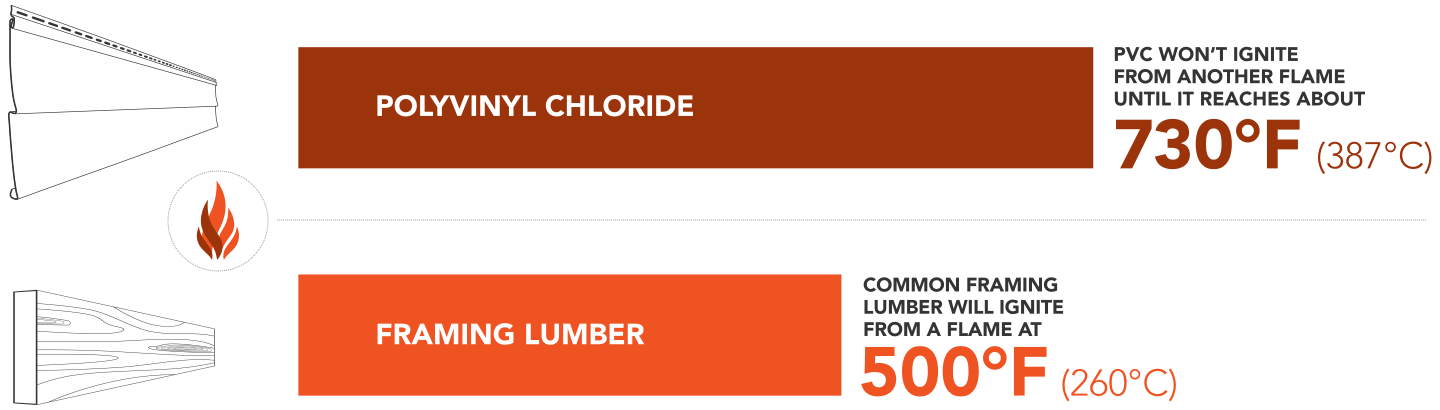
All organic materials (i.e., anything containing carbon) will ignite. But materials with higher ignition temperatures are naturally safer.
Ignition Points:
Colorado and California Wildfire Code Overview
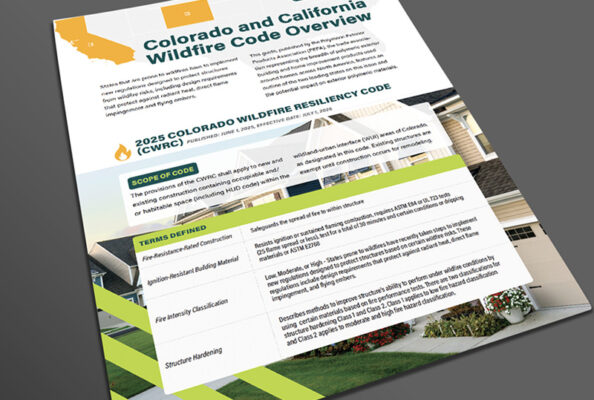
States that are prone to wildfires have to implement new regulations designed to protect structures from wildfire risks, including design requirements that protect against radiant heat, direct flame impingement and flying embers.
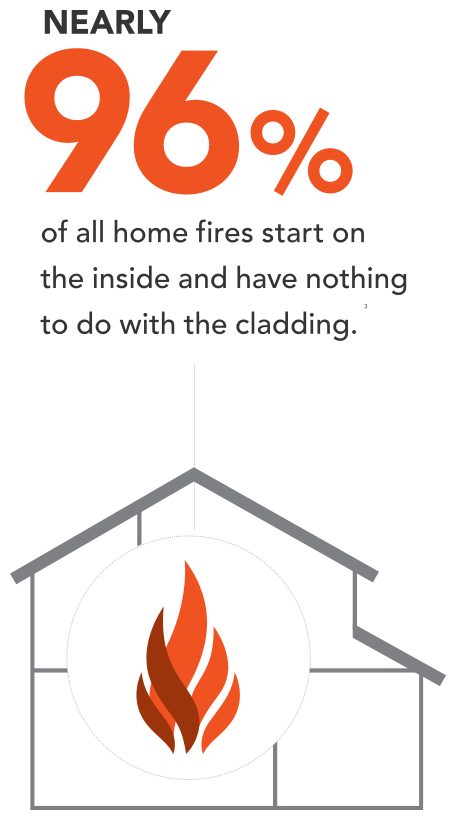
Less than 4% of all residential fires start outside the structure but still do not necessarily originate with the exterior cladding.
Residential Fires: What to Know
Exterior cladding is involved in only a small fraction of all residential fires. Most residential fires begin inside the home and are contained within the structure of origin.
According to a report from the National Fire Protection Association (NFPA), fewer than 3% of all fires go beyond the source inside residential structures and fewer than 2% of these occurrences are related to the exterior wall surface. Less than 4% of all residential fires start outside the structure and do not necessarily originate with the exterior cladding.
PVC Slows Flames from Spreading
PVC, the primary ingredient in vinyl siding, doesn’t release a lot of energy when it burns and will not readily spread flames on its own.2 Vinyl siding also needs unusually high amounts of oxygen to burn and stay burning, so it extinguishes more easily.
Plus, when any organic material burns, it releases smoke that contains many different combustion products including toxic gases. There is no research to substantiate claims that vinyl materials release unusually toxic combustion products.3
The Risks of Combustible Mulch
In many cases today, exterior fires (not in wildfire zones) are started where combustible mulch is present. PEPA encourages better regulation on combustible mulch, and some local jurisdictions are not allowing this product against multi-family structures.
- National Fire Protection Association Fire Analysis and Research Division, Home Structures Fires, November 2020
- Results of ASTM E162-06 test, Standard Test Method for Surface Flammability of Materials Using a Radiant Heat Energy Source
- Fire Properties of Polyvinyl Chloride, Vinyl Institute, 2017
2024 International Wildland-urban Interface Code (IWUIC)
Polymeric exteriors are allowed for use under this code in all conditions with certain performance requirements.
Chapter 5 of the IWUIC breaks down various risk types for developments relative to wildfire risk and then places certain materials requirements. Three different types of risk categories impact the type of Ignition Resistant (IR) wall construction requirement.
In the most stringent IR wall construction Class 1 ignition-resistance construction, Class 2 ignition-resistant construction, and Class 3 ignition-resistant construction, polymeric exteriors may be used so long as they are a part of a 1-hour ASTM E119-rated assembly and exhibit a flame spread index no greater than 25. When a Class 3 condition applies, there are no requirements or limitations on a specific wall construction or cladding type.
In Class 1, noncombustible flashing must be installed at the ground, decking and roof intersections.