New Document Reinforces Polymeric Exterior Compliance with Developing Code
By Matt Dobson, Senior Vice President, PEPA
Wildfire regulations have been growing over the last few code cycles due to increased interest following the recent mass urban and forest fires in California and Colorado.
Experience has shown that reactions to these events have led to costly, and sometimes overreaching, fire code amendments. Regardless of what transpires in code development, vinyl siding and other polymeric exteriors meet code requirements and are acceptable choices for fire safety.
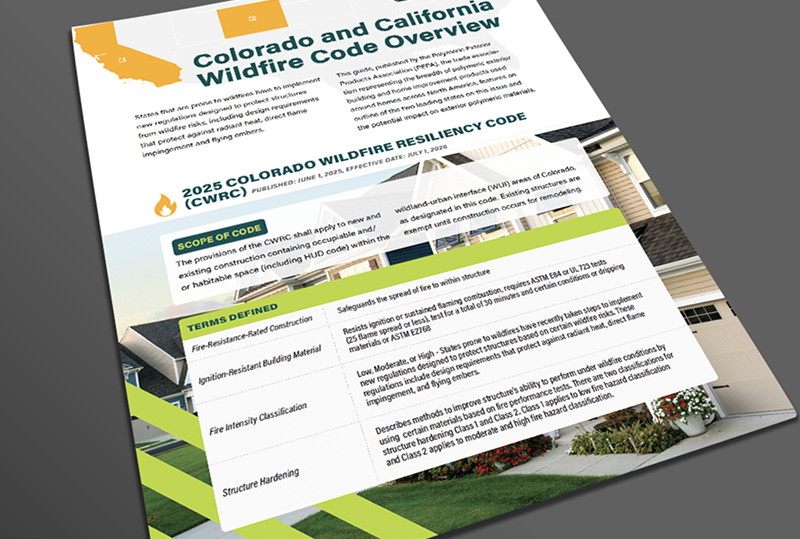
To demonstrate this fact, the Polymeric Exterior Products Association (PEPA) published the Colorado and California Wildfire Code Overview that outlines polymeric exteriors’ compliance with (or exemptions from) these code enhancements.
The new resource guide lists specific sections of the Colorado code that address polymeric exteriors. This includes Building Materials and General Testing Requirements, Roof Coverings and Roof Assembly, Claddings, Appendages and Projections, and Protection of Eaves/Soffit/Fascias). There is also a list of other polymeric considerations like Gutters and Downspouts, Ventilation Openings, Exterior Glazing and Doors (Decking and Building Maintenance).
In general, wildfire building regulations address three areas of risk:
- Flying embers (long distance and land near or on structures in prone areas for fire spread, like roof valleys and deck connections to the structure)
- Radiant heat (hot enough to combust from certain distances)
- Direct flame impingement (the most aggressive form of fire spread, which occurs when flames are in direct contact with the structure, igniting combustible building materials)
Beyond these two states, vinyl siding and other polymeric exteriors meet requirements of the International Code Council’s International Wildland Urban Interface Code (IWUI). The IWUI is the model code as it is established in a way that determines the fire risk of buildings based on:
- Defensible space (speaks to building a buffer around the house structure, i.e., separating the home by 30 to 100 feet from combustible landscaping),
- Climate (the drier the climate, the greater the likelihood for wildfires),
- Topography and slope of site (a steeper property grade acts as a chimney effect),
- Water supply.
No matter the climate or topography, polymeric exteriors do not typically contribute to growth and can be used with fire-rated assemblies without compromise.
Various established and required tests prove this. In many cases, these products will melt and fall away from a building. And as for defensible space, our PEPA Code Development Work Group (CDWG) has played a leading role in advocating for proper defensible space amendments to the relevant residential building codes and in regulating the use of combustible mulch by prohibiting it around structures, especially in wildfire zones.
In the most severe settings, polymeric claddings need to be installed over gypsum board because gypsum doesn’t burn and creates a rated assembly that meets most severe wildfire risk settings.
Learn More in Our Upcoming Webinar
Wildfire-related building regulations are evolving — and with them, questions about how polymeric exterior building products may be impacted. For answers to these questions and a clear briefing on the latest regulatory developments in California and Colorado, join us for a special PEPA Industry Insider Webinar:
Navigating Wildfire Construction Regulations in California and Colorado
April 10 | 10 AM EST
PEPA’s subject matter experts will discuss the Colorado and California Wildfire Code Overview, designed to help PEPA members and industry partners better understand compliance considerations and navigate the changing regulatory landscape.
What you’ll learn:
- The status of Colorado’s wildfire construction requirements expected to take effect in July 2026
- The current reality of California’s Zone 0 regulations and why many market claims are inaccurate
- When testing requirements may apply to polymeric cladding in severe wildfire zones
- How companies can properly communicate polymeric exterior building products’ fire-safe characteristics and how they can be used in most wildfire risk zones safely and successfully
Click here to register. For more information, contact me at mdobson@polymericexteriors.org